
I Lost $50 to a Scam. What It Taught Me That No Course Ever Could
A few weeks ago someone offered to teach me something for free.
He didn’t pressure me, try to sales-pitch me, or ask for money upfront. Just some stranger on the Internet who said he had time and wanted to help me.
So I trusted him. And it cost me $50 and a lesson I won’t forget.
Here’s exactly what happened, and what I want you to understand before it happens to you.
What Happened to Me
I was interested in learning about trading, so I reached out to a stranger who, after some conversations, offered to teach me for free.
He said he had some free time and genuinely wanted to help.
I’ve been on the Internet long enough to know better, yet I still fell for this scam.
There was no pressure, urgency, or double texts. Whenever I wanted to ask him something, he was there to answer without asking for anything in return.
Everything a possible scammer supposedly does, he didn’t do.
So we got on a call. He explained the basics. Calm. Friendly. The conversation flowed naturally and my guard dropped completely.
that supposedly tracks what people are buying and selling in real time. He told me to drag it to my browser bar so I wouldn’t have to search for it each time.
I clicked it. An error appeared — no permission for this page.
He said wait a minute.
And then he removed me as a friend.
$50 gone.
My lesson was learned the hard way.
Why It Worked
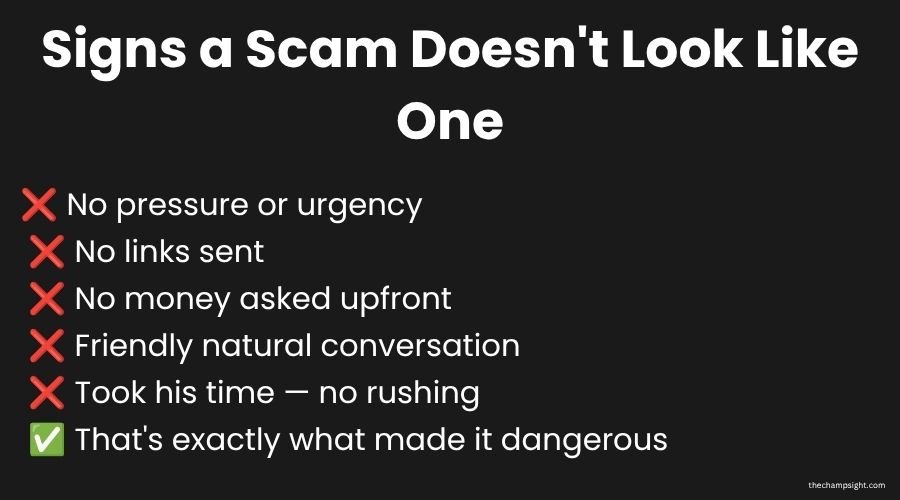
This is the part most people miss when they hear a scam story.
We all think: “How could you ever fall for that? The signs were right there.”
But they weren’t. And that’s exactly the point.
He didn’t push me. He didn’t create an urgency for me to deposit any money. And he didn’t send any link.
The main point is that he talked to me like a friend. The conversation flowed like someone who genuinely wanted to help.
But good scams don’t look like scams. If they did, nobody would fall for them.
These scams look like opportunities. Too good to be true. And most of the time, whenever something feels too good to be real, it’s because it isn’t.
That’s what makes them dangerous, the absence of red flags.
The Lesson — Nobody Gives You Anything for Free
This is going to sound cold. But stay with me.
Nobody gives you anything for free.
Not strangers online, not influencers, not online gurus.
Everyone has a different reason for everything they offer. Always.
Those influencers you see online teaching you how to do e-commerce, trading, or all different types of business, they all have something in common.
They get something in return
The influencer is building an audience for when they have enough trust to drop a course or a paid product.
The person offering free advice is building their reputation, visibility, and trustworthiness.
The free tool is collecting your email so they can later on sell you something.
Even when someone genuinely helps you, they do it because it feels good, and that feeling is the return.
I also want you to understand that even if someone is getting something in return, it doesn’t mean it isn’t worth it.
But I want you to remember this phrase: “Just because someone is winning, doesn’t mean you’re losing.”
Even I’m Not Doing This For Free
This also includes me. And I want to be honest about it because it also matters.
When I recommend some service on this blog, whether it’s Hostinger or even Shopify, I earn a commission if you sign up through my link. When I write these posts I build traffic, reputation, and trust that eventually converts into income.
I genuinely believe in the products I recommend, because I use them myself. But I’m still getting something in return.
It would be hypocritical not to say this. But the lesson isn’t that everyone who offers something is a scammer. It’s that everyone who offers something has a reason to do it. And that includes me.
The difference between me and the guy who scammed me isn’t that we both benefit. It’s that I tell you what I get in return, while he didn’t.
I tell you upfront what I get in my affiliate disclosures. They didn’t.
Want more tips like these? Get weekly insights straight to your inbox. No spam.
The Difference Between Honest and Dishonest Exchange
Most transactions in life involve both sides getting something.
When you pay for a course you’re getting the knowledge, and the creator gets money. It’s a fair exchange.
When you follow an influencer you’re getting the content and they’re getting the reach.
When you’re reading a blog post you’re getting information, and the blogger gets traffic.
None of these are wrong, because in the end all of them involve both sides benefiting. And when both sides know what’s happening and agree to it, that’s how value is created.
The scam wasn’t wrong because he benefited from me or our interaction. But because he hid what he was getting.
Always ask yourself if this person’s benefit comes at your expense without your knowledge.
How to Protect Yourself Without Becoming Cold
Going through a scam will make you cold. It doesn’t matter if you don’t want to become one. You’ll eventually become paranoid and distrust everyone, start to refuse help, and assume every kind gesture is some type of trap.
That’s not the lesson I’m trying to teach you.
The lesson is to think alongside your feelings, not only with your heart, but with your head.
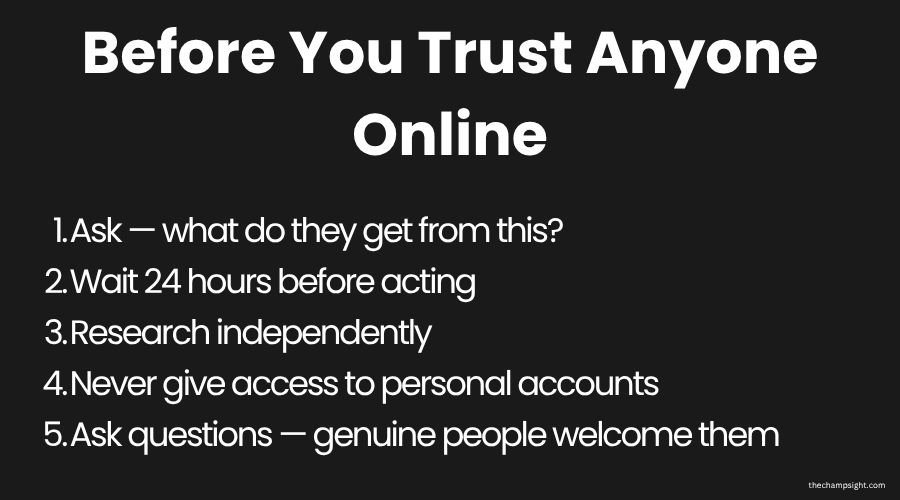
When something feels too good to be true, pause. Ask yourself this question:
What does this person get from this?
If the answer is clear and honest, great. You don’t always have to win in a transaction, it can also be fair, and it’s still worth making.
But if the answer seems to be nothing, look harder. There may be something you’re not seeing.
And if you can’t find the answer even after thinking and looking for it, slow down before you take action.
I wanted so badly to learn how to trade, and that got into my head. Instead of watching videos from the thousands of options online, I would get a chance to learn from someone who actually does it, like a mentor.
Scams often rely on momentum. If something feels urgent, wait 24 hours before taking action. Removing the pressure gives you time to think clearly.
What to Do When Something Feels Too Good
Never Give a Stranger Access to Your Personal Accounts
No matter how legitimate it looks. No one needs to have access to your bank account, trading balance, or your money in general.
Research Independently
If I took the time to search for the reason he scammed me, I would still have the money.
Ask questions, if they’re genuine, they’ll be more than open to answering any questions related to your questions and doubts.

Final Thoughts
Getting scammed cost me $50. But that wasn’t the point. It wouldn’t change my life.
But what actually cost me was the comfortable feeling that generosity is simple.
That when someone offers something freely they want to help.
And that feeling was naive. And losing it made me sharper.
Even though I still perceive some acts as generosity, I keep questioning myself if it is that simple.
This world isn’t cold because everyone has a reason. It’s just honest.
Know what people get from giving you something, and then decide if the exchange is fair.
Most of the time it will be, and most people offering these things have honest reasons.
But sometimes they don’t.
And that’s what stays in your head forever.
Remember.
People don’t have to lose for you to win.
Subscribe for More Mindset Insights
You May Also Relate