
How to Plan Your Week in 30 Minutes (Simple System That Actually Works)
Most people start their week with no plan, and by Wednesday, they feel overwhelmed and stressed.
Not because they’re lazy.
But because they never decided what actually matters.
A weekly plan doesn’t need to take an hour or two, and it’s easier to make than most people realize.
If you’re building a business, having a plan will actually make your mindset stronger, but it won’t give you results just because of the plan.
If you can take 30 minutes to make a plan for the week, your levels of productivity and focus will change completely.
Here’s exactly how to plan your week.

Why Most People Don’t Plan Their Week
But some assignments are made to help you make your life easier.
By sparing 30 minutes of your day to plan your week, you’re saving important time that could be used on urgent matters.
Most people feel like they don’t have time, but is it really what’s happening?
Most of the time, we’re using our time incorrectly.
You don’t know what to do, and you waste time thinking about what to do first.
But when you already set a plan, that time already includes what should be done, according to your goals.
They Don’t Know Where to Start
Some people want to start planning their week, but they don’t know where to start.
They start thinking that they need the perfect system, with all assignments written down in detail.
But reality is much simpler than that.
You just need a simple structure to help guide you during the week.
They Tried Before But Failed After 2 Days
When you decide to plan your week without doing any research, you’re most likely to fail.
Not because you aren’t putting in enough effort.
But because you’re putting too much.
A weekly plan is made to stop you from feeling overwhelmed, not to make you.
They Think Planning is for People With a Complicated Schedule
If you’re struggling to manage your time, then a plan is definitely for you.
Whether you feel like you don’t have that many assignments, it doesn’t matter.
When I was playing football, getting my degree, and working, I felt that it wasn’t enough for me to make a plan.
But I was wrong.
I was still busy. I felt like I didn’t have the time for anything.
If you feel the same, take 30 minutes every week to design your plan.
Why a Weekly Plan Matters

Planning your week will help you manage your time. But it also helps you build your focus, discipline, and even motivation by turning it into a routine.
You Stop Reacting to Your Day and Start Directing It
Have you ever felt like you’re always going based on what your day leads you?
Instead of reacting to everything that comes in your way, you decide in advance what really matters.
When you wake up every morning, you ask what the plan is for today, but you don’t have any.
By having a plan, you had already made that decision on Sunday. And all you have to do now is execute it.
You Catch Problems Before They Happen
A weekly plan also helps you catch problems before they even happen.
Instead of rushing to finish an assignment that needs to be done by Friday, on a Thursday night, you already have it planned for Tuesday.
At the end of the week, you stop feeling like you’ve survived, but you’ve moved forward and lived.
You Reduce Decision Fatigue
Sometimes, when I know I need to post, it occasionally happens that I feel like rushing, and I don’t feel like working.
But when I start to plan it, my mental energy stays intact, that’s because I already know what should be done.
By doing that, I can start doing something earlier, even if it’s only a little.
Because at the end of the day, starting is much harder than continuing.
The 30 Minute Weekly Planning Process
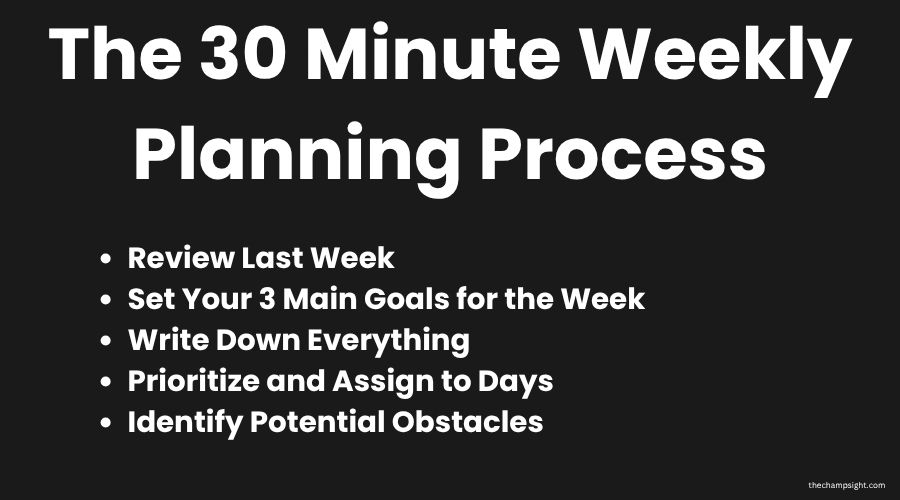
This is the exact process I’ve been using every week.
I didn’t want it to take more than 30 minutes, and wanted something that covers everything without overcomplicating it.
Step 1 - Review Last Week (5 minutes)
Personally, this has been the greatest game-changer.
Before planning the new week, look at the old one.
Ask yourself and write down: What have you finished? What didn’t get done, and what’s the reason? What’s your motive to keep going?
Be honest with yourself, remember that this is for your own good. Don’t try to minimize everything just for you to look good.
That’s how you stay in the same place.
Understanding why something didn’t happen is the first step to improving.
Was it because of the assignment being unrealistic?
Did you have something unexpected come between you and your work?
Did you avoid it?
The review is made for you to learn and move forward, without repeating the same mistakes and patterns every week.
Step 2 - Set Your 3 Main Goals for the Week (5 minutes)
Setting your main goals doesn’t mean making a to-do list.
You don’t need 20 tasks. Find 3 things that would make that week a success, if accomplished.
Everything else comes after your 3 goals. When deciding what to work on each day, remember to revisit these three goals to see if they’ve already been accomplished.
Most people fail because they try to set 20 different assignments. By doing that, you’ll feel overwhelmed and demotivated because you won’t be able to finish them all.
Pick 3 and protect them. Don’t change just because something feels more urgent.
Step 3 - Write Down Everything (5 minutes)
Take a blank page and write down every new idea you’ve got.
Every task, obligation, and every responsibility in your head.
I remember buying an agenda just to take notes every day.
It helps me visualize everything. We’re all humans, it’s normal to forget something.
By having an agenda or even your phone, you’re protecting them.
Don’t you hate the feeling of forgetting something that felt so fascinating?
That’s why I started writing down everything.
Don’t organise it yet, just write down what’s in your head onto paper.
It’s not good for you to have everything in your head and constantly try to remember it all.
After it’s written, you can finally relax because you don’t need to make more effort to remember it.
Step 4 - Prioritize and Assign to Days (10 minutes)
After writing everything down, transform those ideas into assignments during the week.
Be realistic. Like I said earlier, one of the reasons most people quit is because of overwhelming themselves with 10 different tasks in a day, based on their feelings.
Even if you feel ambitious and more motivated than ever today, it doesn’t mean you’ll feel like that tomorrow.
What I do that helps me:
- Place your hardest and most important assignments on Monday.
If you don’t work on weekends, you’re probably going to feel more energetic at the start of the week.
- Leave Friday lighter.
You’ll probably feel less motivated and energetic during the final days of the week.
On Friday, reflect on everything that didn’t get done earlier.
If you’ve been avoiding a specific task since Monday, put it on Friday.
Don’t let it follow through every day of the week. Finish it as soon as you can.
Step 5 - Identify Potential Obstacles (5 minutes)
Look at the week ahead and ask what could get in the way of it.
Do you have any appointments or commitments that could be affecting your available time?
Sometimes I decide to work on Wednesday, but after I take a look at my schedule, I realize that I can’t.
If I had had an idea of these events earlier, I could’ve been working earlier, even if it was only 15 or 30 minutes every day.
By planning your work around these events, you are avoiding the feeling of being surprised by them on the day.
Those who stick to their weekly plans aren’t the ones with the most perfect weeks you can imagine.
But they have time for imperfection because they reserved a certain time in advance.
Want more tips like these? Get weekly insights straight to your inbox. No spam.
Common Mistakes to Avoid
Planning Too Many Tasks
This is the most common mistake. You are motivated on Sunday and decide to fulfill your schedule every day.
By Wednesday, you’ve realized most tasks were abandoned.
Always plan less than you think you can do. Something can happen when you get in front of your day.
If you think you can really get it done, add some more. Because you can always add more.
But you can’t erase the frustration of failing and falling behind.
Not Reviewing the Previous Week
If you decide to skip the first step of your plan, you’re missing all the lessons you could’ve learned.
You’ll always be repeating the same mistakes you’ve been making.
You’ll always avoid the same tasks.
It only takes 5 minutes. But those 5 minutes that you didn’t want to spend can save you from hours of disappointment.
Being Too Rigid
Life is unpredictable. No one knows what’s going to happen.
You can be stuck in traffic, the Internet may be gone, or you can be having the worst day of your life.
Build flexibility into your plan.
Don’t pack every hour of every day. Learn to take breaks.
When and Where to Do Your Weekly Plan
I’ve tested both Sunday evening and Monday morning before I started working.
For me, what works is Sunday evening because If I leave it for the morning, I rush or skip it.
In the evening, before I go to bed, I plan everything that I need. And if I remember something else, I’ll add it on Monday morning.
Pick one that you can actually be consistent with. Because consistency matters more than timing.
Where you do it matters less than actually doing it, but I try to do it at the same place every time.
That builds my momentum and my routine. I sit down in the same chair, with the same agenda, or even an app, which helps me stay productive.
I always use Notion and Google Docs when writing on the web. It’s easy to navigate, and I can find everything by the title.
Final Thoughts
A weekly plan won’t make your week perfect.
You need to understand that anything can happen.
But it helps you make it intentional.
If you do it for weeks, it will compound to months. After some months, you’ll be able to see the results you’ve been waiting for.
You don’t need it to be complicated. You also don’t need expensive software.
You just need 30 minutes on Sunday evening, or Monday morning, to sit down and follow what you planned.
The difference between feeling busy and making progress is having a plan.
Get Weekly Insights on Business and Productivity
Related Posts

I Lost $50 to a Scam. What It Taught Me That No Course Ever Could