
How to Set Goals You Will Actually Achieve
Most people set goals at the start of the year and forget about them within weeks.
Not because they lack discipline or ambition, but because they don’t know how to set goals.
The biggest example is the gyms.
They are busiest in January, with attendance spiking from 30% to 50%, because of the New Year’s resolutions.
Achieving your goals is not about writing them down once and hoping they will come true on their own.
It’s about setting them up the right way, by breaking them into steps and allowing you to pursue them when your motivation is low.
Learn how to set goals you will actually achieve the right way with simple strategies to stay consistent.

Why Most Goals Fail
Most people don’t fail because of a lack of hard work.
They fail because most of the time, the way they set their goals makes success difficult from the beginning.
Here are the most common reasons goals fail.
They’re Too Vague
When people decide to set goals, such as “I want more money.” “I want to be successful.”
These aren’t goals. They’re just wishes.
When your goal doesn’t have a clear definition, your brain doesn’t know what to work toward.
And when you don’t know what you’re working towards, you usually don’t take action.
If you never define what success looks like, you won’t ever fail. But you can’t win either.
Without a specific target, you have higher chances of losing focus and quitting before you even start.
There’s No Deadline
When there’s no deadline, there’s also no urgency.
When your goal isn’t urgent, then everything else becomes more important than it.
When I was younger, I was always saying that I would start next week, and then the week after.
And that’s when most people fail.
The perfect time to start was yesterday.
There’s no reason to wait. When you truly want something, you should start right now.
There’s someone out there starting today, while you are waiting for the perfect time.
Based on Outcomes You Can't Control
When you set expectations you can’t control, the chances of actually achieving your goals become much harder.
“I want 10000 followers in three months.”
The problem with these goals is that you can’t control how many people will actually follow you.
You can only control how many videos, posts, and pieces of content you publish.
Being consistent and not failing your schedule is the only way to make it come true.
When you keep setting goals based on results and performance, you’re setting yourself up for frustration.
Because even if you do everything by the book, there’s no guarantee that the result you’re expecting will come as fast as you wanted.
There's No Review System
Most people set a goal at the beginning of the year and don’t look at it again until the last month.
If you don’t keep reviewing your goals, you’ll lose sight of them.
It stops being relevant, and eventually, the reason why you set it will be forgotten.
You need to constantly revisit your goals, your progress, and what’s working and not working.
The Difference Between a Goal and a Dream
Many people don’t know the difference between goals and dreams.
And that’s why they never move forward.
A dream is something you want. It’s often vague and open-ended.
A goal is something you are constantly working toward with a plan to strengthen it.
It’s specific and actionable.
Dreaming about financial freedom feels great.
Deciding to work for 12 hours per week with almost no free time and trying to get your first customers is something completely different.
Dreams are important because they give fuel to your ambition.
But just like motivation, without a plan, a dream is just entertainment.
Think about it this way. Most people have dreamed about starting a business, writing a book, or even building something meaningful.
But most of the time, it never happens.
Not because they suddenly stopped wanting to achieve it.
But because they keep dreaming instead of making it a goal.
The moment you decide to set a deadline and a first action, it becomes something you can work toward.
Turning your dream into a goal is the first step toward making actual progress.
How to Set Goals That Actually Work
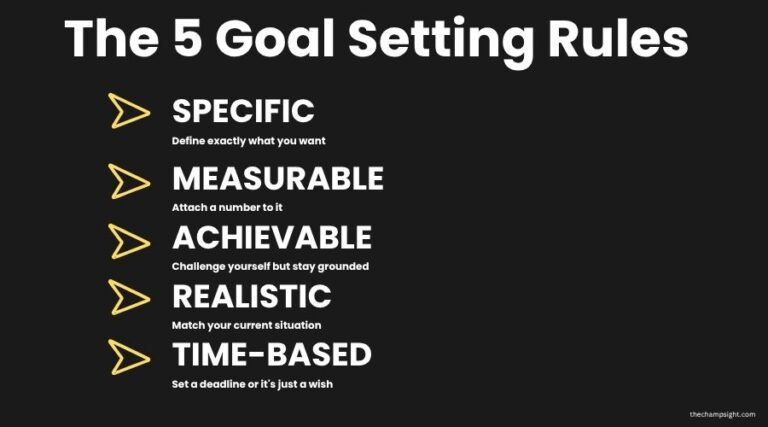
Now that you understand why most goals fail and the difference between goals and dreams.
It’s time to actually understand how to set the ones that work.
The way you define your goals determines whether you’ll be able to follow them or give up after a couple of days.
It’s not complicated, and you don’t need a fancy system.
You just need to ask yourself the right questions before committing. Staying consistent with those answers is what makes the difference.
Be Specific
The more specific your goal is, the easier it becomes to take action.
Instead of focusing on the broader aspect of the sentence, focus on the journey.
“I want to grow my social media” is not a goal. “I want to post 10 times a week for the next 6 months” is the goal.
The first one doesn’t give you anything to work with.
The second one tells you exactly what to do.
You shouldn’t rush the process. Sit down and ask yourself:
“What do I want to achieve?”
Make it as detailed as you can.
Make it Measurable
When setting a goal, you should attach a number to everything.
If you can’t measure your goal, then your progress can’t be tracked.
And how will you know if you’re doing well if your progress isn’t being tracked?
You can’t.
“I want more revenue” needs to change to “I want to increase my company’s revenue by 15% in 6 months.”
Now you have something concrete to work toward.
Keep it Achievable
Just because you can set goals doesn’t mean you should be aiming for the sun.
If you’re just starting, don’t set “impossible” goals.
It will make you quit before you even get started.
Set goals that challenge you, but that you know are possible to achieve.
A goal should feel slightly uncomfortable, require effort and hard work, but that isn’t so far out of reach.
Stay Realistic
This is where most beginners fail.
Don’t set a goal to make $10,000 in your first month of starting a business.
It doesn’t matter if it’s E-Commerce, DropShipping, Blogging, or SaaS.
Don’t set a goal to hit 200,000 Instagram followers in 30 days while doing organic marketing.
Unrealistic goals won’t motivate you. It will only discourage you.
When you’re working towards something you feel like is impossible, you’ll feel like you failed.
Even if only a week has passed. Start from where you are.
Don’t expect years of consistency to happen in one month.
Time-Based
Set a date for your goal. When you don’t, your goal becomes a wish.
What is the time frame for accomplishing your goal?
Ask yourself when you are planning to finish your goal.
It doesn’t matter if it’s in a month, a year, or 10 years.
Deadlines create urgency that leads to action.
When I started this blog, I told myself I wanted to grow it.
But the moment I set a goal to publish 100 quality posts in my first year, I actually started moving.
I still don’t have 100, not even half of it. But I’m being consistent for it to happen.
Want more tips like these? Get weekly insights straight to your inbox.
Short Term vs Long Term Goals
Most people focus only on one or the other.
And that’s why most people don’t know how to set goals.
You need both approaches, and here’s why.
Short-term goals are what you’re working toward for under a year.
They will keep you focused on what’s happening at the moment.
You’ll get small wins that will build the momentum you actually need to remind you why you’re moving forward.
Without short-term goals, you’ll feel overwhelmed, unmotivated, and you may even feel like quitting.
And that’s when long-term goals are important.
Long-term goals are where you want to be in 1 to 3 years.
They give you a destination. All the small things you’re doing every day will lead to this big goal.
Without them, your short-term actions have no purpose.
How to Make Short-Term and Long-Term Goals Work Together
Your short-term goals are the little steps you take to actually arrive at your destination.
If you’re deciding to have 1000 newsletter emails in your second year.
Then your short-term goals must be to add valuable content to your audience for the next 3 months.
After getting 10 contacts, it will come to 100, and it will keep growing.
If you focus on the 1000 contacts, you’ll feel far away.
The One Goal Rule

Many people fail not because they don’t have goals.
They fail because they have too many.
They want to grow their business, start another one, learn another business model, get fit, and move to another country.
All at the same time.
When you do this, you end up making zero progress on any of them.
Your attention and time are limited, like your energy.
When you split all three across many different goals, you end up not giving 100% on any of them.
That’s why I follow the one goal rule.
Pick one main goal for 6 months and go all in on it.
Everything else becomes secondary, and there’s no option to switch before that timeline has passed.
It’s only for 6 months. Not forever.
I talk to a lot of people in different business models than my own.
And sometimes I feel the urge to switch because it feels better, faster, and more reliable than mine.
And because of talking to some of those guys, I learned that every business model works.
The problem is that people don’t work on it for long enough.
They keep switching.
After 6 months, you evaluate.
Did you hit your goals? If yes, set the next one.
If you didn’t, then ask yourself why it happened and adjust it.
You don’t need to learn 50 different things to be better than everyone else.
You just need to do one thing better than everyone else.
What to Do When You Miss Your Goals
You will miss a goal at some point. Everyone does.
But the real question isn’t whether it will happen. It’s what you do when it does.
Most people feel that they’re not good enough just because they missed a goal.
They may quit, switch directions, or even tell themselves that it just wasn’t meant for them.
But that’s not true.
Missing a goal gives you information for your next ones.
When you miss a goal, ask yourself these questions:
- Did I actually put in the work?
Be honest with yourself. Don’t say yes just because you are emotional.
Think about the work you made, and if the answer is no. Then you know that you need to work more.
- Was the goal realistic?
Like I was saying when talking about setting goals, sometimes we set goals that are never achievable given our current circumstances.
- Did something outside my control get in the way?
Sometimes circumstances change, and the goal needs to be adjusted.
Nowadays, we’re almost at war, and depending on where you live, your circumstances are different from those of others.
It’s not something you can control, and because of that, you shouldn’t just abandon your dream, but adapt it.
Those who reach their goals aren’t the ones who never miss a goal.
They’re the ones who never stop.
Final Thoughts
Setting goals isn’t about being perfect or even having everything figured out from the day you start.
It’s about giving yourself a direction that you won’t miss for anything.
It doesn’t matter if the progress feels slow and you want to quit. You don’t.
Most people spend their lives waiting and waiting for the perfect moment.
But they don’t realize that there is no perfect moment.
Start with one goal.
Make it specific, measurable, achievable, realistic, and give it a deadline.
Keep reviewing it every while, and adapt it along the way.
Time will pass either way. The only question is whether you’ll have something to show for it.
Get Weekly Insights on Mindset, Business and Productivity
You May Also Resonate

I Lost $50 to a Scam. What It Taught Me That No Course Ever Could