
How to Get Traffic to a New Blog (From 0)
Everybody can start their blog, and it’s easier than it has ever been.
If that’s where you are right now, you’re not doing anything wrong.
You’re just at the beginning.
But getting traffic is the hardest part of blogging, and it’s where most people fail to do it and eventually quit.
You publish your first posts, maybe even promote them on social media, and you expect something to happen.
But then you realize that nothing happened.
You open Google Search Console, and you don’t see impressions or clicks.
I know the feeling, I’ve been living with that for some months, and it took me a long time to actually see consistent clicks.
Here’s exactly what actually works to grow a new blog from 0 to 100 visitors per day.
Why New Blogs Struggle to Get Traffic
Lack of Domain Authority in the Google Sandbox
Most people think that their blog isn’t getting traffic because of its quality.
But in most cases, quality isn’t the problem.
I’ve seen much better quality posts from recent bloggers than from authority domains.
The problem is that Google still doesn’t trust your blog yet.
You don’t have enough content, and nobody knows who you are.
Every blogger goes through this phase.
It can last from 3 to 6 months regardless of how good you actually are as a writer.
No Backlinks
A backlink is another website linking to yours.
This is what separates you from the strongest bloggers out there.
Whenever someone is trying to state facts, they backlink from authoritative domains to transmit trust.
Competition Against Established Websites
In most niches, you aren’t competing against other new bloggers.
You’re competing against sites that have been online for years with more than a hundred posts.
They have a presence on social media and in communities, and you’re just starting.
The Two Types of Traffic
Two types of traffic can generate traffic for you: Active and Passive.
Understanding the difference between active and passive traffic helps you know where to focus depending on your current stage.
Active Traffic
Active traffic comes from you promoting your content.
Whether it’s you using Pinterest, Reddit, TikTok, or other platforms, it generally helps you get traffic a lot faster.
But the problem is that it’s less consistent and requires constant work from you to keep promoting it.
Passive Traffic
Passive traffic comes from Google and Bing search results.
It takes longer than active traffic for several reasons, but in the long term, it’s the most consistent way to get traffic.
Someone types a keyword, and your post appears to them.
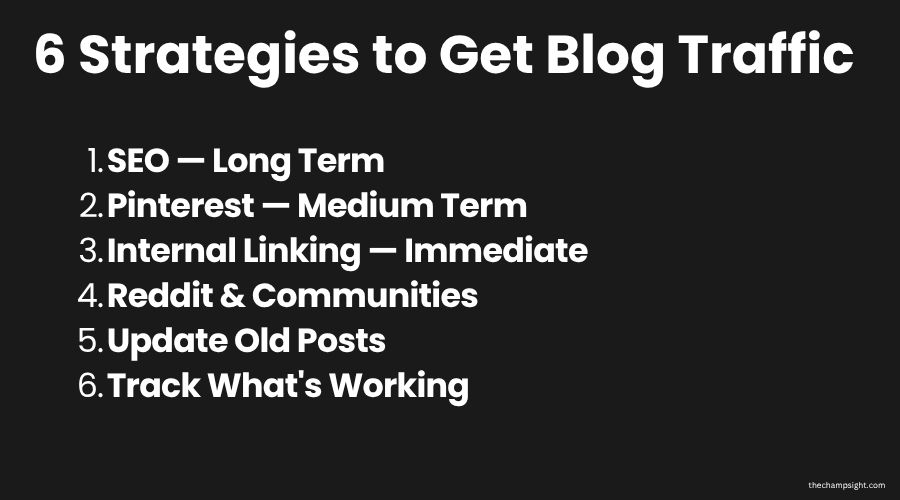
Strategy 1 — SEO (Long Term)
SEO is how you’ll be able to get consistent traffic without needing to be constantly promoting.
Every post you publish is an opportunity for you to rank for a keyword that people are actually searching for.
And the moment you start to rank on the first page, that’s when traffic comes in a consistent way.
And that’s why SEO is the most valuable asset for long-term strategies.
How to Do it As a Beginner
Target long tail keywords.
Instead of trying to compete against websites targeting keywords like “how to make money online”, target something like “how to make money online working from home as a beginner.”
You can use free tools and websites to target more specific and lower competition keywords, such as Also Asked, People Asked, and Ubersuggest.
In the meantime, Google Search Console actually shows you what keywords are actually ranking for.
Optimize every post title, description, image, and URL, including your target keyword, to tell Google what your post is about.
Ranking on Google is one of the best long-term traffic sources for a new website.
If you’re still struggling with your blog, check out my free blogging checklist
Strategy 2 — Use Pinterest to Get Traffic Faster (Short and Medium Term)
I can confidently say that Pinterest is the best traffic source for recent bloggers.
Unlike Instagram or TikTok, where posts just disappear in the first 48 hours, Pinterest pins can last forever.
You decided to create a Pin today, and after one year, you’re still receiving feedback from it, and in some cases, you’re receiving even more feedback than when you posted it.
You must post consistently.
If one day you decide to post 10 pins, but the next day you won’t post anything.
Consider reducing the number of contents published.
It’s far more important to publish in a consistent way than to decide to post everything at once and then disappear.
Use keywords in your pin descriptions. Pinterest works the same as Google.
People search for topics, and Pinterest shows pins that actually match.
As Google, you must tell Pinterest what your content is, they won’t show it to anyone.
Start from your first day. Pinterest takes more than just 3 months to compound.
Building a blog too?
I share real results, mistakes, and what’s actually working each week.
Strategy 3 — Internal Linking (Immediate)
This strategy is what I regretted not investing more in when I started.
I decided to publish a post, then on the next one, I didn’t talk about it.
After 10 posts, your content is buried on your blog page.
Every internal link connects your posts so Google can navigate through them.
It’s passing authority from one to another. This way, Google can understand which posts are the most important on your website.
When I was starting, I only thought that internal linking should be done when I was more advanced.
But I was wrong, and if you think the same, you’re also wrong.
If someone suddenly lands on your blog from Pinterest, they shouldn’t have to move to another page just to see a post.
You should be the one leading them.
If you’re talking about cooking, don’t do an internal link about football.
Always make internal links to related content.
Later on, if you post about something that can be related to your first post ever, make sure to go back and optimize it.
Strategy 4 — Reddit and Online Communities
Using Reddit and Online Communities to promote your content can help you in a way SEO can’t.
It generates traffic within days, not months.
My biggest advice is for you not to promote your blog immediately, but to get trust first.
Otherwise, you will get silenced by the audience, and in some cases, even banned from the community.
Spend time actually providing value, answering questions, and sharing advice.
Nowadays, if you type some keywords, you can see that in some cases, Reddit posts are on the first pages, even in front of high authority blogs.
Strategy 5 — Update and Improve Old Posts
Most beginners publish a post and never go back to it.
They focus completely on writing new content and completely ignore older content.
That’s the biggest mistake they’re making.
Older posts are already indexed, and some of them are already ranking.
When you decide to improve older posts, you can make more progress than just making new content.
Sometimes, high authority blogs lose their spot on the first page because they don’t update their content.
As time passes, new strategies come, and if you’re always updating your content, you’re always fitting new trends into your content.
Find your posts ranking in position 15-25. It’s the closest you are to page one.
Improve internal linking, SEO, and even your content.
Pages in position 8 generate a lot more traffic than those in position 15.
Strategy 6 - Track What’s Actually Bringing Traffic
Instead of checking your stats every day, track weekly .
Checking every day will get you disappointed. You need patience.
Use Google Search Console to see what posts are closer to page 1, and make some content around that post.
If you’re in your second month, don’t pay too much attention to this.
That’s because Google still doesn’t trust you, and your stats aren’t accurate.
But even small growth matters, trust in your results, not your feelings.
What Doesn't Work for New Blogs
Save your time avoiding this:
Posting on Instagram or TikTok Without a Strategy
These platforms are highly competitive, and if you’re just posting without adapting your content to the platform, you’re going to fail.
Focus on Pinterest and on online communities.
Buying Traffic or Backlinks
If you’re paying for traffic without having a monetized blog, you’re just losing money.
And when you’re losing money, you have a higher chance of quitting and feeling overwhelmed.
Bought backlinks can also be penalized by Google, don’t go through shortcuts that will make your journey worse.
Publishing Without Keyword Research
If you’re just starting a blog for personal reasons instead of thinking of it as a business, then it’s completely ok.
But if you want your blog to succeed, you should be thinking about the content you’re creating.
Always check for the keyword you’re writing before actually posting it.
Check if someone actually searches it, and if you can compete with other bloggers.
Switching Strategies Every Two Weeks
If you decide to invest in a strategy, focus on it. Don’t abandon it after 2 weeks just because you’re not seeing progress.
2 weeks isn’t enough time to rate a strategy and to see if it’s really working.
SEO takes months, not weeks. Pinterest takes months. Reddit takes time to build a reputation.
If you decide to stop after 2 weeks and start another strategy, you’ll always feel like nothing is working.
What’s Actually Working For Me
I’m still not getting as much traffic as I wanted to.
But I’m seeing clicks growing every month, impressions growing every week, and posts indexing even faster than ever.
I’m also seeing Pinterest getting me traffic, and with internal linking, I can also see people clicking on other posts.
On the other hand, I’m focusing on SEO, and I can see posts jumping in position from my first month to today.
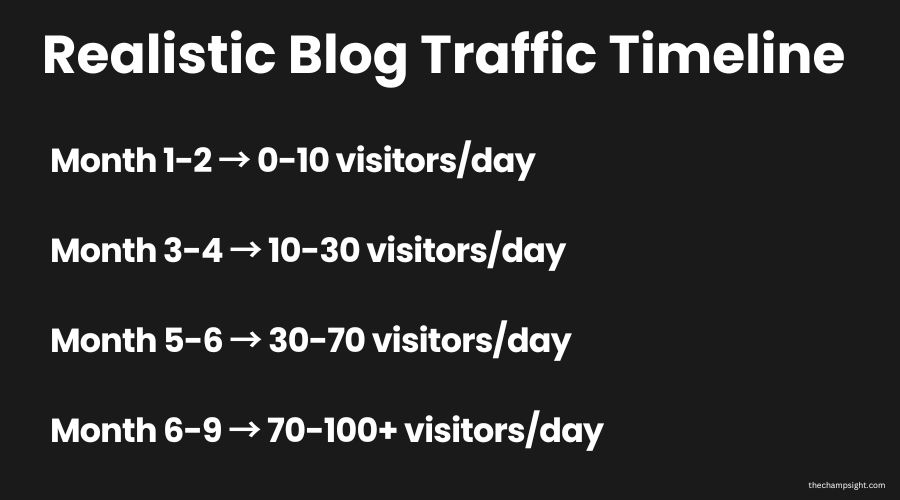
Realistic Traffic Timeline
This is the most realistic traffic timeline, not the inflated one you keep seeing online.
Month 1-2 → 0-10 visitors per day. Almost nothing. Normal. Keep going.
Month 3-4 → 10-30 visitors per day. First consistent organic clicks appeared. Pinterest is starting to send occasional traffic.
Month 5-6 → 30-70 visitors per day. First page 1 rankings for long tail keywords. Pinterest compounding. Reddit contributing if you’ve been consistent.
Month 6-9 → 70-100+ visitors per day. Multiple page 1 rankings. Pinterest is driving regular traffic. SEO is starting to compound significantly.
Final Thoughts
Getting to 100 visitors per day is harder than jumping from 100 to 500 visitors per day.
You’re building your own land, while on 100-500, you already have it.
It will take months, in some cases even years, but there are no shortcuts.
You need to be constantly improving, putting in the work every day, combining SEO with social media, internal linking, and even community building.
Most bloggers don’t fail because blogging doesn’t work. They fail because they quit before it does.
Get Weekly Insights on Business and Productivity
You May Also Like