How to Stay Patient When Your Blog Isn’t Growing (Beginner Guide)
You started your blog with motivation and a plan.
You decided to publish consistently, watch guides on how to get traffic, and invest in social media for traffic.
But after some weeks, you’re staring at Google Search Console with almost no clicks, wondering if this is actually worth it.
I know the feeling. To be completely honest with you, that was me some months ago.
But that’s part of how blogging works.
Here’s how to be patient when your blog isn’t growing.
Why Blogging Feels So Slow

Blogging is slow because nothing is instant like almost everything in our world.
And most people expect their blog to work like social media.
But the moment you decide to publish a post, Google won’t rank you immediately, especially when starting.
Most of the time, people won’t find you right away.
Your content will be there, unnoticed, until Google decides to do something about it.
When you start a blog from a new domain, you’ll be like a small fish in the middle of the ocean.
It will be hard for you to be seen, and that’s because what you’re building is invisible at the start.
And that’s why it seems like there’s no reward for your work.
Why We’re So Bad at Being Patient
We live in a world where instant results are dominating more and more.
Same-day delivery. Overnight success stories. Get rich-quick guides.
Everything around you is designed to give you what you want, when you want.
Then your brain starts to adapt to it. You would rather watch short-term content instead of a movie.
You can’t stay quiet for more than ten minutes.
Then you also keep seeing people showing you their results, but you keep forgetting one crucial thing.
Those results you’re seeing aren’t the first 3 months, it’s month 12, or 24, or even 36.
Comparing your beginning to someone else’s middle or even prime will always make you feel like you’re behind.
You might actually be doing better than they were at your stage.
Difference Between Waiting And Patience
Most people don’t know the difference between waiting and having patience.
Waiting is passive.
You just sit and do nothing, hoping that something actually appears in front of you.
Patience is the complete opposite.
It’s active.
You keep working, even though you don’t see results.
You create content for social media, improve your images, and focus on providing value to communities.
That’s having patience.
And when you’re launching a blog, those, with consistency, are the most important qualities that someone can have.
It will be like talking to no one, at least for the first 3 months.
What’s Actually Happening While You Wait
I know the feeling when Google Search Console shows you zero clicks and low impressions.
If you don’t have a strong purpose, continuous thoughts about quitting will keep running in your mind.
But here’s what actually happens while you wait:
Google is Slowly Trusting Your Content
Every week your blog is live, consistently posting every week without failing, it’s another week of trust.
Even though you can’t see it, it’s certainly happening.
You’ll realize that posts are quicker to be indexed, instead of taking more than a day, and sometimes, almost a week.
Your Social Media Is Compounding
I always recommend people who decide to start a blog to use Pinterest.
Pinterest isn’t like TikTok. The moment you post something on TikTok, you can have a like immediately.
But Pinterest is the same as blogging.
One pin can actually take months to be seen by someone, and more months to be saved.
But as blogs, your first pin can generate traffic to your website even after a year.
Every pin is like a permanent piece of content.
Your Impressions Are Growing Even If Clicks Aren’t
In my 3rd month, I’ve seen impressions growing more and more. Instead of having less than 100 per week, I started having 500.
That’s because people were actually searching topics that I wrote about.
At the same time, Google is showing your content to real people.
You’re Building a Content Library That Will Work For Years
Most people say that a blog post can generate more than 80% of your traffic.
And they’re right.
You only need a good post on page 1 to succeed.
After that, what determines if you really succeed is your ability to do internal links to other posts and collect your audience’s emails for them to come again.
If you don’t do that from the beginning, you have a higher chance of failing.
Your posts won’t expire, so when someone clicks on your post, they can see others, and the loop continues.
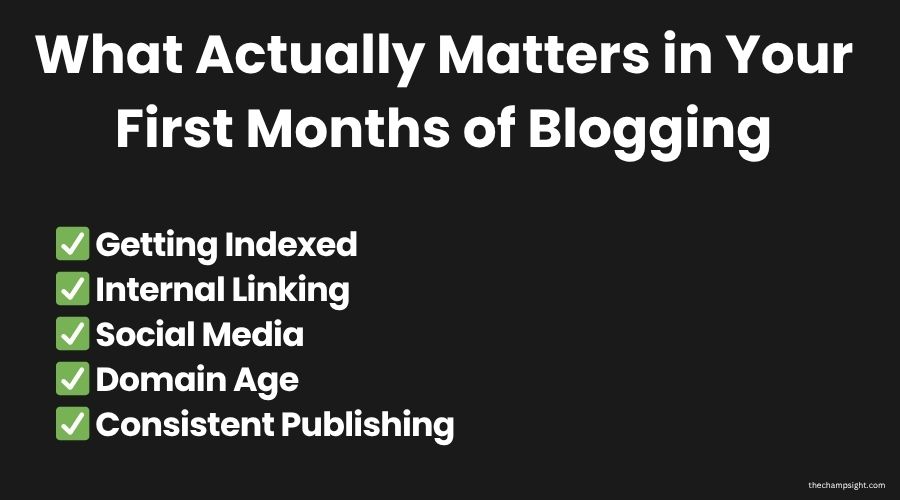
What Actually Matters In the First Months
This is where most people decide to skip.
Everyone keeps telling you to post consistently and be patient.
And they’re right. But they never tell you what actually matters in the first months.
Getting Your Posts Indexed
Before Google can rank your content, it needs to actually find and crawl it.
After you publish a post, go to the Google Search Console and index your post.
The more consistently you publish, the faster this happens.
Internal Linking
This is the most important thing on blogs.
Every internal link you add connects your posts into a system that Google can navigate.
It keeps passing authority and helps Google to actually understand what your blog is, and what posts are the most important.
Even if you only have 5 posts, make sure to connect them.
Social Media
Start creating content from day one.
You can even use Canva to transform your posts into content.
Most of my early traffic came from social media, mainly Pinterest.
That’s because I decided to create pins from the very first day, and until now, I haven’t failed a day.
It’s said that Pinterest can take up to 6 months to compound, so start as soon as you can.
Don’t try to make 10 pins a day, start small, and if you can, increase the quantity.
Remember, quality over quantity.
Building a blog too?
I share real results, mistakes, and what’s actually working each week.
Signs Your Patience Is Paying Off
When everything feels like it’s falling apart, try to look for anything that can prove that something is actually happening.
Impressions Growing Every Week
Even if it’s growing from 100 to 150 impressions. That’s visible growth.
It might sound low, but those small wins are crucial for your success.
Social Media Getting Traction
Depending on what channels you’re using to promote your blog, social media can also feel lonely.
But after some time, maybe after 30 or even 50 social media posts, you finally see a like, save, or even a view.
That means that someone is actually there, and you’re making it work.
When starting, everything feels small, but every small win compounds until it’s bigger than you ever imagined.
You’re Still Publishing
You haven’t quit.
Even though you might want to.
Those late nights working late, researching new ideas to succeed, or even new business models to try.
But you didn’t. You’re still here.
As long as you don’t quit, you’re still ahead of the majority of bloggers who started when you did.
As long as you’re here, you can succeed.
Those who quit will only know the cost.
How to Be Patient
Measure Weekly, Not Daily
Start setting weekly goals to track your progress.
Daily numbers fluctuate too much to mean anything.
A day with 0 clicks means nothing if you had 100 on the week.
And a day with 100 means nothing if you end up with 100 clicks in that week.
But if you see that your clicks and impressions are growing week after week, that’s a sign of growth.
Don’t let a specific day make you feel like it’s not working.
Set a Minimum Timeline Before Considering Quitting
If you decide to quit after 1 month, you won’t have any data to judge anything.
You didn’t give it enough time.
Give it at least 6 months before judging anything, from clicks, impressions, or even money.
Those first 6 months are too early to tell you anything, especially on blogging.
Focus On What You Can Control
Instead of focusing on whether you’re getting clicks, start focusing on writing quality posts.
Focus on being consistent every week, promoting your posts, investing in social media, and improving every day.
You can’t control whether Google ranks you, and you can’t control if someone clicks on your blog, but you can control how much you publish, create, and promote.
Put your energy into what you can control.
Stop Comparing Your First Months to Someone Else’s Prime
It’s not the first time I’ve written about this, but nowadays this is what holds the majority of people.
They decide to quit because someone else is ahead of them.
But those who’re ahead aren’t in their first month.
And even if they are, they have more experience than you.
If you never played basketball, do you expect to shoot like Stephen Curry?
Everything takes time, and certainly that person you’ve seen also had bad times, but they stayed to the point of seeing the results of it.
The hardest part of blogging isn’t writing. It’s staying consistent while results are still invisible
If you’re still struggling with your blog, check out my free blogging checklist
Compound Effect of Patience

Every post you publish will compound later. As you keep creating value, it will rank higher and higher.
The same applies to social media.
Compounding is invisible at first, it’s the same as investing.
Every dollar you put in will keep compounding for some time, and it will be much more than you initially invested.
And when that happens, make sure to still be here, posting every week.
Those who make money from blogging weren’t more talented than you.
But if you decide to quit, they sure have more patience, and that’s why they succeed.
Final Thoughts
No traffic in month 3 doesn’t mean your blog isn’t working.
It means you’re in the phase that tries to push away everyone who isn’t serious about it.
Most bloggers quit before month 6.
Not because blogging doesn’t work, but because they ran out of patience before the results arrived.
You can’t control when that happens. You can only control whether you’re still there when it does.
Keep going. The foundation is being built even when you can’t see it.
Get Weekly Insights on Business and Productivity
You May Also Like