
How to Build Simple Habits That Stick (Beginner Guide)
Most people fail because their habits don’t last.
Not because they lack motivation.
Have you ever noticed that when you’re starting, you feel super motivated and ready to prove everyone wrong?
But after a few days, or maybe some weeks, you fall back into your old patterns.
It’s not because of laziness or because you simply can’t focus.
The truth is that you’re not using the right approach.
Here’s how to build habits that actually stick.
Why Most Habits Fail
Before learning how to build habits that stick, you need to understand why most habits fail in the first place.
Setting Habits That Are Too Big
Most people, when deciding to build a habit, immediately go all in.
With social media, influencers and “gurus” are normalizing waking up at 5 a.m. every day, exercising, reading, and even meditating.
I’ve been there. I’ve tried to do that, but after 3 days I quit.
It is the most exciting feeling on Sunday. You are ready to change your life.
But when you decide to do it all at once, without starting small, focusing on small habits that will compound, you’re setting yourself up for failure.
They Rely On Motivation
I always say that motivation is the fuel that you need to start.
But it’s not what keeps you going for weeks, months, and years.
If you create a habit according to your motivation, you’ll only do it when you feel like it.
Habits only work if you show up, especially when you don’t feel like it.
They Miss One Day And Quit
One missed day becomes two. If you get to the point of failing two times in a row, it will be really hard to come back.
When I talk about this, I always remember this quote from a show I watched when I was younger.
“You can quit if you want, but remember, quitting’s a very hard habit to break.”
When I was starting this blog, I always felt the urge to not post one day and move it to another.
But I already know myself and my habits. If I did that, you wouldn’t be reading this.
Don’t give yourself the option to skip today’s work.
There’s a big chance you’ll never do it.
They Pick Habits Disconnected From Their Goals
If you don’t understand what your goals are, then there’s no point in having habits.
Decide why you are building habits before actually doing it, you’ll stop doing it the moment it becomes inconvenient.
Ask yourself:
“Why am I doing this?”
Even if you’re feeling overwhelmed, having a goal at the end of the road will keep you moving.
The Science Behind Habits
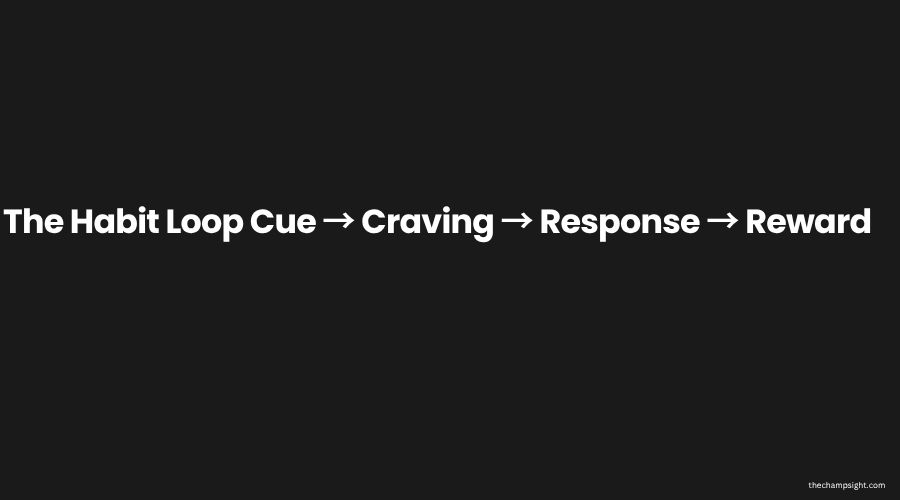
Every habit follows the same pattern – cue, craving, response, reward.
The cue is what triggers the habit, whether it is your alarm, finishing a meal, or even sitting at your desk.
This signals to your brain that a reward is coming.
The craving is the motivation that the cue creates.
You’re craving the feeling transmitted by the habit, not the habit itself.
You don’t crave going to the gym, you crave being healthier and more muscular.
You don’t crave starting a business, you crave the money, financial freedom, or being your own boss.
The response is the habit itself. Whatever behaviour you perform, that’s your response.
It could be writing, reading, or learning new skills every day.
Finally, the reward. This is what you get after completing it.
The satisfaction, the sense of accomplishment.
Rewards will teach your brain that what you’re doing is worth repeating.
Without a reward, it’s the same thing as telling your brain that you’re doing this for nothing.
Every accomplishment is a reason to celebrate, no matter how small.
This is the framework behind Atomic Habits by James Clear. And it’s exactly how I build my own habits.
I have a full list of mindset books on my blog, and this is one of the best in that category.
If you want more insights about productivity, mindset and building an online business, consider joining my newsletter.
The One Habit Rule
Most people try to build five habits at once.
After a few days, they fail at all of them.
Pick one habit for the next 30 days. Don’t quit, and don’t change it.
Just one.
Everything else is secondary until that first habit is implemented in your routine.
After you stop thinking about making that habit, but actually do it like it’s automatic, you can focus on the next one.
One habit for 30 days. All in.
How to Build Habits That Actually Stick
Now that you understand why habits fail, here’s how to actually build simple habits that stick for beginners.
1. Start Smaller Than You Think
Like I was saying earlier, most people fail because they start too big.
If you want to do everything at once, building a business, studying, having hobbies, going out with your friends, and even training, you’re setting yourself up to fail.
When starting, it can work, at least for a few days.
Then something called life happens. You had a bad day. You didn’t sleep well.
Then you miss one day. You realize those habits were too big for you.
You start enjoying not doing the work. Then you quit.
Start smaller than feels necessary.
When starting, your goal isn’t to be the most performant. But to actually show up.
Let your habit become automatic before increasing the output.
2. Attach It to Something You Already Do
This was what helped me actually start to build habits.
When I was having breakfast, I always decided to add something after that.
“After having breakfast, I will open my blog draft.”
The idea is to trigger a new habit by implementing it on an older one.
After X is done, I will do Y.
3. Make It Obvious
Your environment can help you or crush you depending on how you use it.
Every time I enter my room and turn on my computer, the first browser page I see is my blog, or something related to it.
Designing my environment so that habits are the easiest and most obvious choice available to me.
Instead of having a YouTube video, or even a movie there, the moment I turn on my computer, I actually have some work that needs to be done first.
Remove the things that compete with your habits and put the things you need for it to be built.
4. Track Your Habits
Every day you complete the habit, mark it.
You can use anything: a calendar, a notebook, or even an app.
It doesn’t matter what you use. What truly matters is that you’re able to see your streak.
And when you miss one day, because you probably will, don’t get demotivated.
The rule is very simple.
Don’t let it become two missing days.
One missing day is an accident, but two missed days are the start of a new habit.
And that’s the habit of quitting.
5. Be Patient
Most people think habits can take less than a month to form.
But according to research, the average is closer to 66 days.
Smaller habits like drinking water can obviously take less time, and more complex habits can take significantly longer.
But my point is: don’t expect your habit to be built in 3 weeks.
Your habit may still feel like an effort, and like a decision that you have to make every day.
But by the time you’re around day 30, you’ll feel it more automatic.
It’s not easy to build habits, there will be days when you’ll want to quit.
But those who build lasting habits didn’t find it easy.
They kept going past the point where most people decide to abandon it and quit.
Final Thoughts
Habits aren’t built in a day.
They’re built in the small decisions you make every single day when nobody is there forcing you to do anything.
It will depend only on you.
Instead of trying to maximize everything from the beginning, focus on starting small.
Attach it to something that already exists daily. Make it as easy as it can.
And even if you miss a day, make sure to show up the next morning.
Don’t be like me, who once said, “I’m still too young to build habits.”
That time was many years ago, if I hadn’t started this blog, I would still be the same young guy who once said that.
You don’t need more motivation. You need a system that makes you stay consistent even without motivation.
Because habits don’t change your life overnight…
But over time, they change everything.
Get Weekly Insights on Mindset, Business and Productivity
Related Posts

I Lost $50 to a Scam. What It Taught Me That No Course Ever Could