
How to Build a Night Routine That Sets You Up for Success
Everyone talks about morning routines.
You wake up early, don’t touch your phone, and get straight to work.
But here’s what most people miss. Your morning routine starts the night before.
During this post, I won’t be talking about how you can choose between a morning or a night routine.
I think you should have both, and depending on what you prefer to do, adapt it to your needs and qualities.
What you do in the last hour before you go to sleep determines how rested you are.
Here’s how to create one that actually works.
Why Your Night Routine Matters More Than You Think
Most people end their day randomly.
They scroll through social media before they fall asleep, and most of the time, they stay up later than they planned.
If you were like me, you used to go to bed unplanned for tomorrow, and feel overwhelmed by everything you didn’t do on that day.
And when I woke up, I felt tired. I always had one habit, it didn’t matter what day it was.
I always used to check my phone before I could even think properly.
But that isn’t a morning problem. That is a night problem.
The quality of your sleep will affect your focus, energy, and even decision-making the next day.
If your sleep was terrible, you won’t have the same willingness and energy to do everything you have planned.
And what you do the hour before you sleep determines how good or how bad your sleep actually is.
If your mornings feel chaotic and unfocused, the fix might not be waking up earlier. It might be what you’re doing the night before.
What Most People Do Wrong at Night
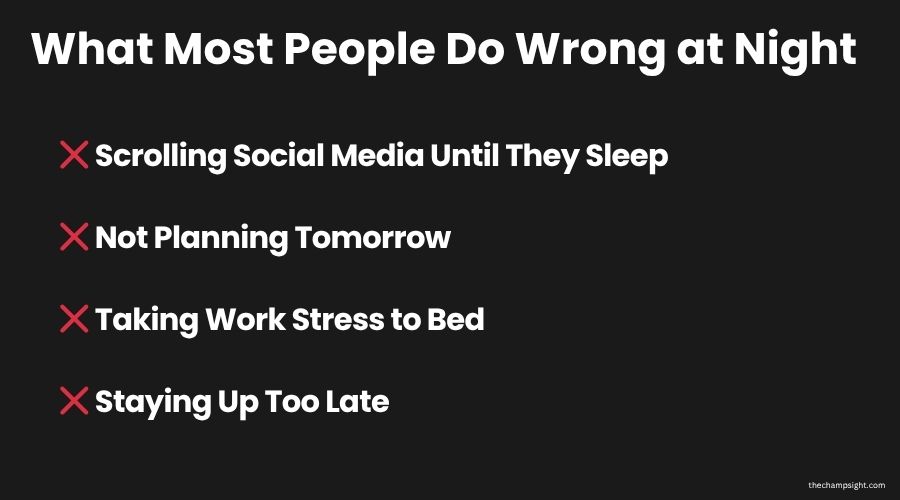
Before trying to build a better night routine, I advise you to understand what’s wrong with yours.
Scrolling Social Media Until You Fall Asleep
According to research by Harvard, the blue light from your phone disrupts your body’s ability to produce melatonin.
Has it ever happened to you that you may fall asleep, but after you pick up your phone, suddenly you feel like you have a lot of energy?
That’s because of melatonin, you’ll stay up later than you’ve intended, but your sleep will be a lot worse, waking up like you never rested.
Even if you slept for more than 8 hours.
Not Planning Tomorrow
When you go to bed without a clear plan for tomorrow, you will waste your first hour of the day figuring out what to do.
That’s your clearest and most focused being used on decisions that could’ve been made the night before.
Instead of leaving everything for the next morning, make sure to take care of those things the night before.
Taking Work Stress to Bed
If the last thing you think about going to bed is everything you didn’t do the day before, you aren’t letting your brain rest.
Most of the time, we can’t resist thinking about it, but if you let those thoughts ruin your day, you’ll ruin your next day.
Make sure to finish everything before actually going to sleep, and if you can’t control what’s going to happen, try not to think about it.
Staying Up Too Late
One late night can happen. But don’t let it become a habit.
A pattern of late nights will destroy your focus, energy, and mostly your consistency, and that’s the most important thing about a routine.
Want to Build Better Routines?
I share weekly insights on productivity, mindset and building something real — straight to your inbox. No spam. Just what’s actually working.
How to Create a Night Routine That Actually Works
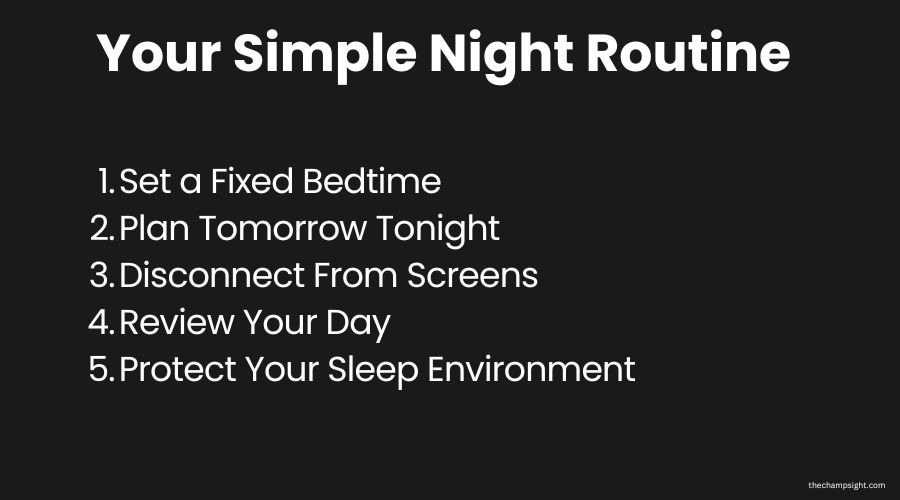
As I stated in the morning routine guide, you don’t need a complicated system. You need a simple sequence that you can follow every single night without failing or feeling like a burden.
Here’s what worked for me, so you can implement it on yours.
Step 1 — Set a Fixed Bedtime
Same time every night.
Let your body build a natural sleep cycle. When you go to bed at a consistent time you’re letting your body build a natural sleep cycle.
If you fall asleep at different stages of your cycle, you’ll wake up feeling groggy regardless of how many hours you slept.
Pick a realistic bedtime that gives you 8 hours of sleep before your fixed wake-up time.
Don’t let social media trick you into waking up at 5 a.m. every day.
Pick a time and commit to it, even on weekends. Even when you feel tired or not motivated, just keep consistent to make it work.
Step 2 — Plan Tomorrow Tonight
This is the most impactful thing you can add to your night routine.
Before you actually go to sleep, write down your 3 most important assignments for tomorrow.
You don’t need a full to-do list, start with 3.
Then check your calendar to see if there’s anything that can affect your day.
Are there any appointments or even deadlines?
Make sure to plan them now instead of feeling rushed in the morning.
Finally, lay out everything for tomorrow. This was what made me much more productive.
I started to do everything for tomorrow instead of looking for motivation to do it in the morning.
Every decision you make tonight is one less decision you have to make tomorrow morning — when your mental energy is best used for actual work.
Step 3 — Disconnect From Screens
I’m not saying that you need to turn off everything for 2 hours.
But at least 30 minutes before bed. Turn off your phone, TV, or even laptop.
This isn’t just about the blue light, but your mental state.
Social media, notifications, and news stimulate your brain in ways that make winding down harder.
You’re consuming when it’s time to rest.
Replace screen time with something that tells your brain that the day is finally over.
You can read a physical book, write in a journal, or even stretch.
I like to listen to calm music because it makes me relaxed.
The goal is to create a clear transition between the active part of your day and sleep.
Step 4 — Review Your Day
Spend 5 to 10 minutes at the end of each day doing a brief review.
Make sure to write down what you accomplished, what got done, and what didn’t go so well.
This serves a purpose of more than letting your brain know that day is over, but it gives you data on how you’re actually spending your time versus how you think you are spending it.
Keep it short. 5 minutes maximum. The goal is closure, not analysis. Internal link → Weekly Planning post.
Step 5 — Protect Your Sleep Environment
The environment that you sleep in matters more than you realize.
Make sure to have a dark room that prevents your brain from being signaled that it is daytime.
You can use a sleep mask or even dark curtains.
Your body temperature will naturally drop during sleep. Make sure that you have a cooler room that makes that process easier to improve sleep quality.
Finally, make sure to put your phone far from your reach.
The temptation will always be there, so make it harder for you to be tempted.
Your evening should be yours, no phone before sleep, during the night, and immediately when you wake up.
What a Simple Night Routine Looks Like

You don’t need a whole hour to set yourself up for tomorrow. Here’s how my 40-minute night routine that covers everything I need looks:
10:00 PM – Plan tomorrow. Write the 3 most urgent assignments for tomorrow.
Check your calendar and prepare your environment for tomorrow morning.
10:15 PM – Review today briefly. What got done, what went well, and what didn’t.
Find a single win on your day.
10:20 PM – Turn off your phone, desktop, laptop, or TV. Make sure not to have it near you.
10:20-10:40 PM – Wind down, do some stretches, or read a physical book.
10:40 PM – Lights off, ready to sleep.
Simple. Repeatable. Effective.
Why Most Night Routines Fail
Most people fail their night routine for one simple reason.
They Try to Change Their Entire Life Overnight.
The Routine Was Too Complicated
They decide to read for 30 minutes, write in a journal, meditate, or even do a full skincare routine and be in bed by 10 p.m.
But that’s not how it works, especially when starting.
That will work for three days, but suddenly, one night, they’re tired, they skipped one step, and now they think everything has fallen apart.
But that’s not a discipline problem. They’re just overcomplicating how a routine is made.
Scrolling Through Social Media
You keep telling yourself every night that it’s the last video you’ll watch, the last short, or even the last picture.
But then 30 minutes passed. You delayed your whole routine just because you didn’t resist the urge.
Then you wake up in the morning already behind. Not because you didn’t complete your night routine, but because you didn’t sleep enough.
Inconsistency
This can be a complement of the first reason, when your routine is too complicated, it’s very difficult for you to stay consistent, even if you have all the willingness in the world.
A night routine will only work if it happens at roughly the same time every single night.
If you keep shifting your bedtime by two or three hours, you aren’t giving your body a chance to adjust.
It’s like you’re resetting everything in your sleep cycle, not building one.
The best night routine isn’t the most complicated one.
It’s the one you can actually follow consistently.
Final Thoughts
Your morning doesn’t start when you wake up.
It starts the night before.
What you do in that last hour will reflect on the next morning.
You don’t need a fancy routine, just something simple that you can actually follow through.
Start with one thing today, maybe your three most important assignments.
See how you feel tomorrow. After two or three days, add something else.
Build from there.
Get Weekly Insights on Mindset, Business and Productivity
You May Also Relate