
How to Choose a Profitable Niche (Beginner's Guide)
Choosing the right niche is the first major decision you make when starting an online business.
It determines the direction of your business, whether you build an e-commerce store, do affiliate marketing, start a blog, or launch a SaaS.
Many beginners fail because they choose something they personally like or something that is trending.
After a couple of months, they quit because they had no traffic, no monetization path, and no real strategy.
Your niche determines almost everything:
- Your content strategy
- Your monetization options
- Your motivation long-term
In this guide, I’ll show you how to choose a profitable niche using a simple framework that consists of demand, monetization, and longevity.
What is a Niche
A niche is a specialized segment of a larger market for a particular kind of product or service that serves a defined group of people.
It’s not as broad as an industry, it’s a focused position within that industry.
For example:
“Business” is not a niche.
“Online income for college students” is a niche.
A strong niche should have:
- Clearly defined audience
- Specific problem
- Focused Solution
The more specific you are, the easier it becomes to:
- Stand out from the broad market
- Create targeted content
- Monetize effectively
When you try to talk to everyone, you end up talking to no one.
Choosing a niche gives your business a direction on what your position should be from day one
3 FILTERS FRAMEWORK:
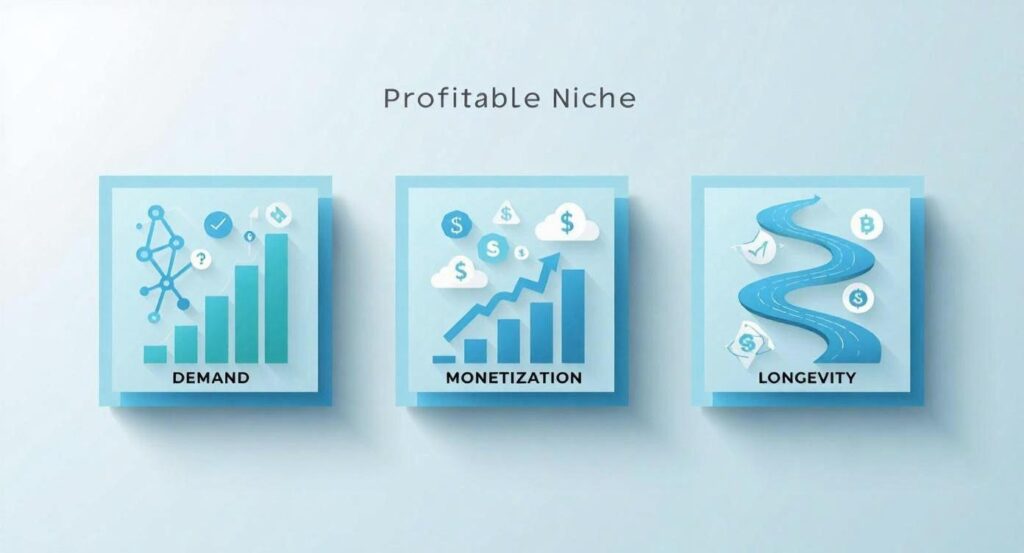
Understanding the concept of a niche is important. But definition alone won’t help you choose the right one.
You’ll probably be asking yourself: “How do I know if a niche is actually worth building?”
Some niches appear promising and exciting, but no one is actively seeking them. Others make money today but won’t exist in five years.
That’s why I’m talking about this structure.
I call it the 3-Filter Framework.
Before committing to any online business, make sure it passes these three tests:
- Market Demand
- Monetization
- Longevity
Your niche must have all three. Imagine a business having monetization potential but no demand. Or it has longevity but no monetization.
Market Demand
The first one, and probably the most important filter, is market demand.
Ask yourself if people are looking for solutions in that space.
Even though choosing something you love is much better for your motivation, if there’s no demand, it will be very hard to monetize.
Don’t choose a niche based only on personal interest.
When demand exists, you’ll notice people searching on Google.
You’ll see communities discussing the topic online, on platforms like Reddi,t or Quora, YouTube, social media, and blogs.
When there’s competition, there’s money and attention in that space.
How to Identify Market Demand
There are a few simple ways to validate your demand before deciding on a niche.
Start by using search engines.
Type potential topics into Google and look at what the suggested search is.
If you see multiple results related to that topic, it usually means people are looking for information or answers.
Followed by search engines, explore communities.
Platforms like forums, Quora, and Reddit can reveal what people are struggling with and what questions they usually ask.
Identify that pattern.
Lastly, analyze existing content and businesses.
If you constantly see creators and companies selling products or services in that niche, it usually means that the market has demand.
You shouldn’t be looking for a niche with zero competition. But one where people already ask for questions, information, and actually spend money.
Monetization
Demand alone isn’t enough.
You may find a niche with a lot of interest from people, but it may still be difficult to turn it into a real business.
Ask yourself how businesses in that niche make money.
Is it from ads? Digital or physical products? Coaching? Courses? Softwares?
The more monetization paths your niche has, the more flexible your business becomes.
If you decide to pursue a niche like fitness and weight loss, it offers multiple monetization opportunities.
You could be selling training plans, coaching, or even recommending supplements through affiliate marketing.
Another example is blogging. When you decide to create a blog, you can monetize it through affiliate programs, post sponsorships, and even ads.
It’s a long-term business that can take years to scale, but it’s better than doing nothing.
If you’re interested in blogging, you can read my article on how to start a blog, where I walk you through the process step by step, just like I did when I started mine.
When there are many ways to generate income, your niche becomes much easier to turn into a business.
- Are people selling products or services in this niche?
- Does it have affiliate programs?
If it’s a yes, that’s a good sign.
It means your niche can support a real business.
Longevity
The final filter is longevity.
Your niche can have demand and monetization paths, but does it last long-term?
Some niches grow quickly because they are trendy, and that attracts attention for a short period of time, but once the trend fades, the audience also disappears.
When you decide to build your business around trend niches, your growth becomes unpredictable.
You want to focus on evergreen niches.
Evergreen markets are niches with consistent demand that don’t rely on trends or seasons. They have lasting appeal and stable growth, continuing to be relevant.
These niches can be around health, pet care, finance, or business. It has existed for decades and will likely continue like that in the future.
People will always want to improve their health, take care of their pets, manage their money, and build better careers.
On the other hand, your niche should also have a possibility to consistently create content.
If your niche has only a couple of topics, you will run out of ideas. Choose a niche that makes it possible to create content for years, not months.
Examples of Profitable Business Niches
To better understand the theory, let’s look at a few examples of niches that usually pass the three main filters.
Health and Fitness
People are constantly searching for ways to lose weight, build muscle, and improve their health.
Because the demand is consistent, you’ll find many monetization opportunities.
But the bigger your niche is, the bigger the competition you’ll have.
Personal Finance
Personal Finance is another powerful niche. People are always trying to learn how to manage their money.
Costs of living are increasing, and people are realizing the importance of investing, saving, budgeting, and building additional income streams.
You can monetize it through courses, financial tools, affiliate programs, partnerships, and even consulting, depending on your portfolio.
Pet Care
Millions of people own pets and are always looking for products, information, and how to take better care of them.
In this niche, you can make money on dog training, toys, health care, or grooming.
Pet owners are willing to spend money on their animals because pets are an important part of people’s lives.
Common Mistakes Beginners Make When Choosing a Niche
Choosing a niche is the major decision when starting an online business, but beginners often make the same mistakes.
Being aware of these pitfalls can save you months of frustration and get you ahead of those who don’t know.
Choosing a Niche Only Based on Passion
People often say to follow what you love. But relying on passion alone can be risky.
Just because you enjoy a topic doesn’t mean there is a market for it. You can be interested in that niche, but still have little demand and opportunities.
Many beginners start building content on what they enjoy. But they don’t research whether people are actually searching for solutions or even willing to spend money on that topic.
Over time, this can lead to frustration because you don’t see your audience growing, and it seems like you’re stuck in the same place for months.
You don’t see progress, and after some months, you decide to quit.
Passion is a great motivator, but it works best when combined with real demand and monetization options.
Choose a niche where your interests align with people’s problems.
Overthinking and Never Starting
When you’re starting, you won’t be perfect. Don’t spend too much time trying to find the “perfect” niche.
You’ll end up comparing ideas and waiting for the perfect opportunity to take action.
While you should do research, overthinking can quickly turn into procrastination.
You won’t actually know if a niche works unless you start creating content and testing ideas, even though you can prepare before.
You can refine your niche over time as you get experience and better understand your audience.
Look at your content’s best results, look for a pattern, and invest in it.
Choosing a Niche That Is Too Broad
Earlier, I talked about popular niches. Even though those niches are evergreen, they are also massive and highly competitive.
You’ll be facing people with years of experience ahead of you, especially when you’re just starting.
Instead, focus on a specific segment of that market.
When we’re talking about fitness, it’s too broad. But “Home workouts” is more focused.
The same can be applied to almost everything.
“Pet Care” is too broad. “Dog training for puppies” is more specific.
Starting with a more specific niche allows you to build your authority on the market much faster and attract a more targeted audience that is looking for your specific solution.
As you grow, you can always expand into related topics.
Choosing a Niche Without a Clear Business Model
Another mistake beginners make is choosing a niche without understanding how it can generate income.
Some people pick a topic they enjoy and start creating content about it without thinking about how to monetize it.
Over time, they realize the topic may attract attention, but there are no clear services, products, or even tools to promote.
Applying the monetization filter will help you avoid this mistake.
Action Plan: How to Choose Your Niche
Now that you understand how to evaluate a niche, you should actually choose one and test it.
It won’t be a perfect niche from day one. But what matters most is starting. Improve along the way and redefine based on your audience.
Write down 3 niche ideas.
Think about markets that you find interesting or where you have knowledge. It could be something from business, fitness, wellbeing, finance, or even teaching.
This is to create a short list of your possible directions.
Apply the three filters.
Take each idea and apply the three filters: demand, monetization, and longevity.
If a niche fails on one of these filters, remove it from your list.
Choose a niche and commit.
Many beginners delay their progress because they can’t make up their minds.
Don’t keep switching ideas. Focus on the niche that looks the strongest and actually commit for a period of time.
Depending on what your business is, it could take months or even years to see results.
There is a lot of competition nowadays, and the most important factor is to be consistent.
Remember that every day, someone is starting an online business, and someone is quitting. In 1 year, more than 70% of those who started will have given up.
Start creating content
The best way to validate your niche is to actually start creating content.
You will learn more from creating and failing than from any guide or endless research.
Before you commit to your niche, use this free validator to see if it passes the 3 filters:
Final Thoughts
Choosing the right niche will shape the content you create, the audience you attract, and the opportunities you’ll have.
The good news is that you don’t need to find the perfect niche on the first day.
Choose a direction that passes the three filters and then start to build your business.
Many successful online businesses didn’t start with the perfect niche. They evolved through failing, experiences, and most importantly, consistency.
In 6 months, you’ll be better than you are today. And in 1 year you’ll be better than in 6 months.
Get the Free Beginner Blogging Checklist
Thinking about starting a blog? Subscribe below and receive my free Beginner Blogging Checklist that shows you the exact steps to launch your blog the right way.
You May Also Like

I Lost $50 to a Scam. What It Taught Me That No Course Ever Could