
11 Blogging Mistakes I Made So You Don’t Have To
In 5 months of blogging, I’ve made almost every mistake a new blogger can make.
Some cost me time, and others cost me rankings. One even got me suspended from AdSense.
I want you to understand that this post isn’t coming from the side of success.
I’m writing from month 5 with almost 50 posts, and growing every month compared to my last five.
I have more knowledge than I had when I started, and that’s what is making me improve month after month.
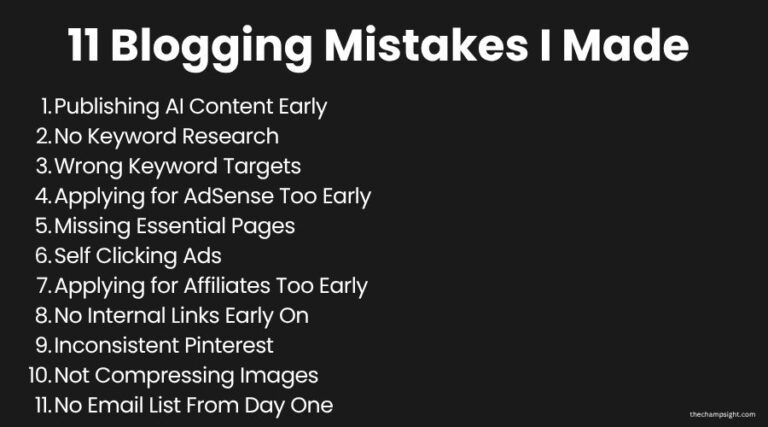
Here are 11 blogging mistakes I made so you don’t have to repeat them.
Disclosure: Some of the links in this post are affiliate links. This means I may earn a commission if you purchase through them, at no additional cost to you.
I only recommend services I personally use and believe can help beginners start their blogs.
Mistake 1: Not Doing Keyword Research From Day One
For nearly two months I wrote about whatever I felt like writing about.
Topics that interested me, questions that I had, and things I thought people would find useful.
But there was a problem nobody told me about. And that was the lack of people searching for those specific topics.
I spent hours writing posts that Google never showed to anyone because the demand wasn’t there.
Until the end of my second month, I didn’t research any keywords. And that held me back a lot, and I wish I had started from my first post.
Mistake 2: Starting My Blog With AI-Written Content
My first three posts were mostly AI-generated.
I thought it would save time, and I also thought people would find it more interesting because AI can gather all the necessary information and put it on a single post.
But even though it saved me some time, the quality was completely poor.
My voice wasn’t there, and it looked like a machine. The perspective was generic, and you could find thousands of posts similar to that.
Months later, I had to go back and improve those posts. In the end, the time I thought I saved cost me double or triple.
What to Do Instead
Write everything yourself from day one. You can use AI to improve the quality of your posts, but your voice, experience, and perspective are what differentiate your blog from the thousands of generic ones.
People follow you because of your personality, if you look like a machine, you won’t be different from anyone else.
Mistake 3: Not Adding Internal Links From the Beginning
Nowadays, I reinforce the concept of internal links and their importance.
When I started, I had only one to two internal links, and that made each post sit alone on my page.
It doesn’t provide you with any authority, and there isn’t a guide so readers can go from one post to another.
Most of my early traffic came from Reddit and Pinterest, and even though readers read the whole post, there wasn’t a given direction so they could explore other content.
This resulted in most of them leaving without reading anything else.
What to Do Instead
Add at least 5 internal links to every post you publish. If some new post fits an older one, update it and make sure to internal link it.
As a beginner, your older posts have higher chances of ranking. By doing the internal linking correctly, you can help those readers find other posts for them to engage with.
Mistake 4: Not Building an Email List From the Beginning
This was one of my major mistakes. I treated my email list as something for later.
When I had traffic, more posts, and even lead magnets. But I was wrong.
A simple signup form is enough if readers actually like your writing style.
Every early post without a signup form is the same as leaving potential subscribers at the table.
Those who accidentally found my blog couldn’t reach me, not because of the quality, but because there was no option for them to do it.
What to Do Instead
Set up a simple signup form before publishing. You don’t need the perfect hook, instrument, or even a large audience.
You just need a reason for people to subscribe and a way for them to do it.
Start collecting emails from day one.
Mistake 5: Not Starting Pinterest Consistently From Day One
As I keep saying in most of the related blog posts, Pinterest is the best way to get traffic without being ranked on Google.
Even though I started Pinterest early, I was too inconsistent, which canceled out most of the benefits of starting early.
I remember there were days I posted 15 pins, but then nothing for a week. That inconsistency made my journey on Pinterest harder than it should be.
My pins weren’t compounding, and because of Pinterest rewarding consistency, I didn’t have any monthly readers until month 4.
What to Do Instead
Find how many pins per day you can do and maintain forever.
Two pins per day will always beat 10 pins per day for a week and then nothing.
Commit to that number and make sure not to miss a single day.
Mistake 6: Applying to Affiliate Programs Too Early
In my first month, I decided to apply to HubSpot, Ubersuggest, and Canva.
I got rejected. I felt discouraged. And even though I knew it was too soon, it still made me feel disappointed.
The rejections were predictable, I didn’t have trust, readers, or a stable audience.
HubSpot specifically told me to come back with 1,000 monthly unique visitors and more B2B content, and some of them rejected me because of low traffic.
What to Do Instead
Focus on providing value, building an audience, and stop focusing too much on affiliate links.
By month 6, you’ll have more results and actually some proof so you can apply again.
Because when you’re rejected once, it could affect your future applications.
Mistake 7: Checking Google Search Console Every Day
This is a mistake I still make. Some days I decide to check my search console, and depending on the results, I can feel either frustrated or happy.
But analyzing your results by day instead of week or month is worse for your motivation and even discipline.
What to Do Instead
Start checking your results by filtering by week. It will tell you more about your progress than checking daily.
There are days when your readers and impressions aren’t as good as you thought. And that’s okay.
The problem with this is that you get overwhelmed and you may think this isn’t working when it’s the opposite. It was just a bad day.
Mistake 8: Not Updating Old Posts
Instead of updating outdated content, people decide to make new content. By doing this, they think they’ll get more results.
But that’s wrong. Usually, older posts are already indexed and even ranking on Google, while newer posts still have to go through that phase.
What to Do Instead
Update your older posts, because as you keep writing, you’ll get more experience and even more quality that can be used on those posts you wrote when you started.
Analyze your higher ranking posts and update them, you can either expand sections or even add proof of value.
Ready to Start Your Blog?
Launch your blog today with my exclusive 20% discount.
No extra cost to you. I may earn a small commission.
Mistake 9: Missing Essential Pages Before Applying for AdSense
As some of you know, I got rejected by Google AdSense 7 times before getting approved.
In the beginning, my problem was the lack of content, but as rejections were appearing, I realized I didn’t have essential pages that Google requires.
If you’re starting fresh I recommend Hostinger — it includes all the essential page setup guidance you need from day one.
What to Do Instead
Make sure to have essential pages such as Privacy Policies, About, Contact, and Terms and Conditions.
It takes a couple of hours, but it will save you months of rejected applications.
Mistake 10: Applying for Google AdSense Too Early
My other mistake was applying for Google AdSense as soon as I created my blog.
I had 5 posts and thought it was enough to prove that I was worthy.
I kept applying, and even though I had more posts, it wasn’t enough.
What to Do Instead
Make sure your blog is well structured, and make sure to have at least 15 posts before applying.
Some people say the number of posts doesn’t matter, but it’s better to have a good quantity of quality posts rather than only 5 and keep getting rejected.
Mistake 11- Clicking My Own AdSense Ads (Big Mistake)
This is the most embarrassing mistake on this list.
If you were accepted on Google AdSense with low visitors or even none, you’ll know the feeling of wanting to make money.
But Google is smarter than you may think it is.
There are thousands of people working at Google, and if you were like me, thinking you could dodge Google, you’re wrong.
You’ll get suspended, and some people will even be banned.
What to Do Instead
Never click your own ads, not once, never.
Not even to test it. Google tracks every click and activity.
Let traffic grow, because as I keep saying, a blog isn’t a short-term business model. It takes a lot of time.
So let time pass and make sure to be consistent; in the end, you’ll finally see results and your Google AdSense will eventually grow.
The Biggest Lesson I Learned After Five Months of Blogging
If I had to summarize everything I learned in one lesson, it would probably look like this:
Time Is The Most Underrated Asset You Have
When I started, I was always focusing on outcomes. Traffic, income, affiliate programs, and even competitors.
But nowadays, what I value the most is time.
If I had started this blog 5 years ago, everything would’ve been better. I would’ve had more traffic, a stable audience, and even more confidence in myself.
Would I?
The truth is that we never know what could happen. But I can say that in 4 years and 7 months I’ll be in my 5th year.
Enjoy the journey of blogging, but make sure to understand that time is what will define whether you will or won’t succeed.
Your consistency during the years, your hard work, and discipline are what really differentiate those who make it and those who don’t.
Instead of focusing on outputs, focus on time. Set goals for the next year, not next week.
Ask yourself what would’ve happened if you stayed consistent for the next five years. Do you think your life could change?
If not, you might consider another business model, because with blogging, you need to truly believe in yourself.
Months will be harder. No feedback, no results, nothing. What will help you is your mindset and confidence to keep going even without any result.
Final Thoughts
Every mistake on this list cost me something, whether it’s time, ranking, revenue, or subscribers.
But even though it cost me all of that, it taught me more about blogging in these 5 months than any course or tutorial ever could.
So, after this post, I can assure you that if you want to learn how blogging really works, start your own.
Because you need to make your own mistakes, that’s part of building something.
But as you start your journey, make sure not to make these specific ones, because they will only drag you and take more time away from you.
Avoiding them will save you months of unnecessary setbacks.
The goal isn’t to avoid every mistake. That’s impossible.
The goal is to avoid the mistakes that cost you months of progress.
If this post saves you even one of those months, then it was worth writing.
Subscribe for More Business Insights
You May Also Relate